- Home
- Photography Tours
- Diary / Blog
- Galleries
- Foreign Trips
- Wet Tropics of Australia 2015
- Australia's Top End 2015
- SW Australia 2015
- Switzerland 2015
- Andalucia 2015
- Belize 2015
- Australia 2014
- Switzerland 2014
- Belize 2014
- Bahama Islands 2014
- Switzerland 2013
- Ecuador 2012-2013
- Florida 2011-2012
- Vancouver Island 2011
- Australia 2010
- Peru 2008
- Bulgaria 2007
- Lesvos 2006
- California 2006
- New Zealand 2005
- Extremadura 2005
- Goa, India 2004
- The Gambia 2003
- About
Ticks & Mites
Class : Arachnida
Subclass : Acari
The Acari are a diverse group of generally tiny species with most being less than 1mm in length, although some ticks can reach up to 20mm in size. There are currently about 50000 species described, but this is considered to be only a tiny fraction of the true number of species alive today.
Superorder: Acariformes
The Acariformes are a diverse group of mites that includes velvet mites, plant parasitic mites, chiggers and dust mites.
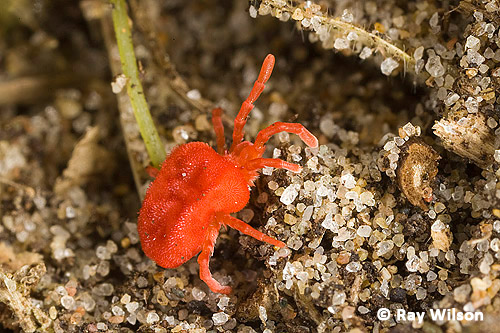
Red Velvet Mite (Order Trombidiformes: Eutrombidium rostratus) - Anglesey, Wales - March 2009
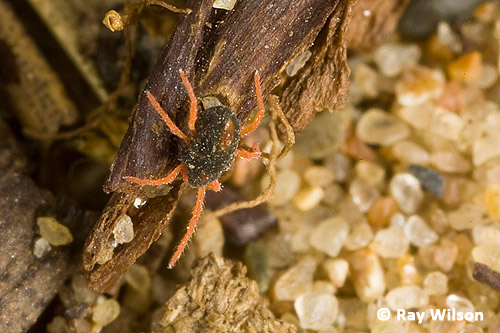
Order: Trombidiformes - Anglesey, Wales - March 2009
Superorder: Parasitiformes
These are mostly parasitic species, the most well known of which are the ticks.
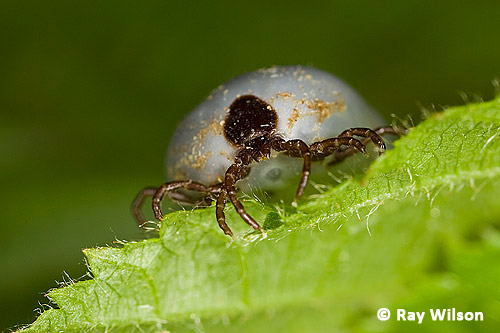
Sheep Tick (Ixodidae : Ixodes ricinus) - Wirral, England - May 2009
Most ticks are haematophagous, living entirely on the blood of vertebrate animals. During feeding they attach themselves to their host by embedding their heads into the skin of their victim, and over the course of several days engorge themselves to such a degree that the abdomen of a fully fed tick is expanded to several times its normal size. The fully-fed tick in the photos here is about the size of a garden pea and was found, and extracted from, the ear of a domestic cat.
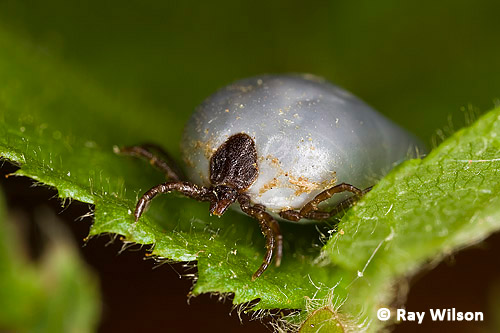
Sheep Tick (Ixodidae : Ixodes ricinus) - Wirral, England - May 2009
Some ticks transmit bacterial and viral diseases to their vertebrate hosts and more photos and information about these can be found in the tick page of vectors of human disease gallery.










Ray Wilson owns the copyright of all images on this site.
They may not be used or copied in any form without prior written permission.
raywilsonphotography@googlemail.com