Home

Diary
Galleries
Foreign Trips
Equipment Used
Stock photography by Ray+Wilson at Alamy
Image contributor for:
Ray Wilson

Bird & Wildlife Photography

Millipedes, Centipedes & Symphylans
Subphylum: Myriapoda
The Myriapoda is split into 4 Classes: Diplopoda (Millipedes); Chilopoda (Centipedes); Symphyla (Garden Centipedes) and Pauropoda. As their name suggests, they all have numerous pairs of legs (minumum 9 pairs; maximum 375 pairs). There are about 13000 described species worldwide.

Class: Diplopoda (Millipedes)
The millipedes are differentiated from other Myriapods by having 2 pairs of legs per body segment. They have the most legs of any animal, but never actually get close to the 1000 legs their name suggests. Even the leggiest species (Illacme plenipes from California, USA) "only" has 750 legs. Most species are slow-moving, detritus feeders. They are generally harmless, but a few tropical species are capable of squirting a caustic liquid as a defense mechanism. This can be particularly painful if it gets into the eyes and may, in some cases, cause blindness.
Pill Millipede (Glomeridae: Glomeris marginata) - Anglesey, Wales - March 2009
If threatened, pill millipedes will roll into a tightly-sealed ball.
Pill Millipede (Glomeridae: Glomeris marginata) - Anglesey, Wales - March 2009
When the danger is perceived to have passed, the millipede slowly unrolls...
Pill Millipede (Glomeridae: Glomeris marginata) - Anglesey, Wales - March 2009
Like most millipedes, the pill millipede is capable of secreting noxious chemicals as a defense against predators. This ant rapidly lost interest in its investigation, allowing the millipede to continue its slow trundle across the sand unmolested.
Black Ant (Lasius niger) investigaing a Pill Millipede (Glomeridae: Glomeris marginata)
Anglesey, Wales - March 2009
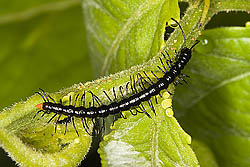
In the tropics, some millipedes grow quite large. The individual below was about 10cm long, but this is still quite small compared to some of the African species which can exceed 30cm in length...over a foot long!
Manu, Peru - December 2009
Tambopata, Peru - December 2009
The two species above and below are representatives of "flat-backed" millipedes. The more 2-dimensional shape of these millipedes allows them to more easily penetrate the leaf litter and narrow crevices. The species below was approximately 15cm in length.
Tambopata, Peru - December 2009
Class: Symphyla (Garden Centipedes)
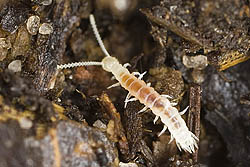
The Symphyla are small, translucent, eye-less, vegetarian centipede-like creatures that live in the soil. Early instar symphylans only have 6 pairs of legs, but by gaining an extra pair of legs at each moult, the adults have a total of 12 pairs. They continue to moult after reaching adulthood, but no longer gain any more legs at each successive moult. There are only about 200 known species worldwide.
Cheshire, England - August 2009
All images are copyright Ray Wilson

raywilsonphotography@googlemail.com