| All of the photos on this page are of captive-reared flies photographed in controlled conditions at the Liverpool School of Tropical Medicine.
The species presented here are:
|
|
|
|
|
|
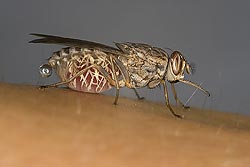
bloodfed female Tsetse fly (Glossina morsitans morsitans)
|
| Through their bite, Tsetse flies transmit the single-celled protozoan parasite Trypanosoma brucei which causes African Sleeping Sickness (or African Trypanosomiasis) in humans and Nagana in cattle. There is no vaccine for the disease and due to the antigenic variation of the parasite it is unlikely that there ever will be. If diagnosed early the disease is treatable, but the drugs currently available are difficult to administer and highly toxic. If left untreated the disease is invariably fatal. There are currently 300,000-500,000 new cases of African Sleeping Sickness per year in the 36 countries of sub-saharan Africa where the Tsetse fly resides, resulting in over 66000 deaths per year. |
|
|
|
bloodfed female Tsetse fly (Glossina morsitans morsitans)
|
| Apart from the human death toll, the economic cost is huge. Throughout large swathes of Africa, it is impossible to raise cattle and horses due to the presence of infected Tsetse flies. |
|
|
|
male Tsetse fly (Glossina morsitans morsitans) probing skin with his proboscis
|
| Tsetse flies are obligate haematophagous insect, which means both male and female flies survive purely on a diet of blood. |
|
|
|
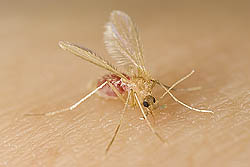
female South American sandfly (Lutzomyia longipalpis)
|
| The phlebotomine sandflies comprise a large group of flies found throughout most of the warmer climes of the world. Of these, about 80 species are known to transmit Leishmania parasites to various host species. |
|
|
|
female South American sandfly (Lutzomyia longipalpis)
|
| In South America, Lutzomyia longipalpis is the main vector of visceral leishmaniasis, a lethal form of the disease if left untreated. Similar to African Sleeping Sickness, the available drugs are toxic and there is no vaccine. |
|
|
|
feeding female South American sandfly (Lutzomyia longipalpis)
|
| Unlike Tsetse flies, sandflies only require bloodmeals for the development of their eggs. Male sandflies never bite and the females can survive for long periods on a diet of sugar-water. |
|
|
|
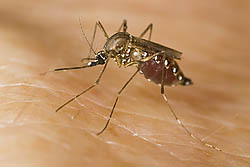
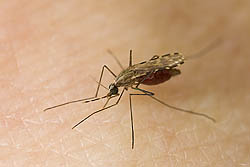
female mosquito (Anopheles gambiae)
|
| The biggest killers of them all are the anopheline mosquitoes. The species shown here, Anopheles gambiae, is the main vector of malaria in Africa and, through the injection of Plasmodium parasites into the host during feeding, is responsible for over 1 million deaths per year, mainly in children under the age of five. |
|
|
|
female mosquito (Anopheles gambiae)
|
| Unlike the previous two diseases, safe prophylactic drugs are available for malaria, but many are becoming less effective due to the development of resistance by the Plasmodium parasites and new drugs are desparately needed.
Thanks to Lee Haines, Paul Bates and John Morgan for allowing the flies to sit on, and bite, their arms.
|
|
|